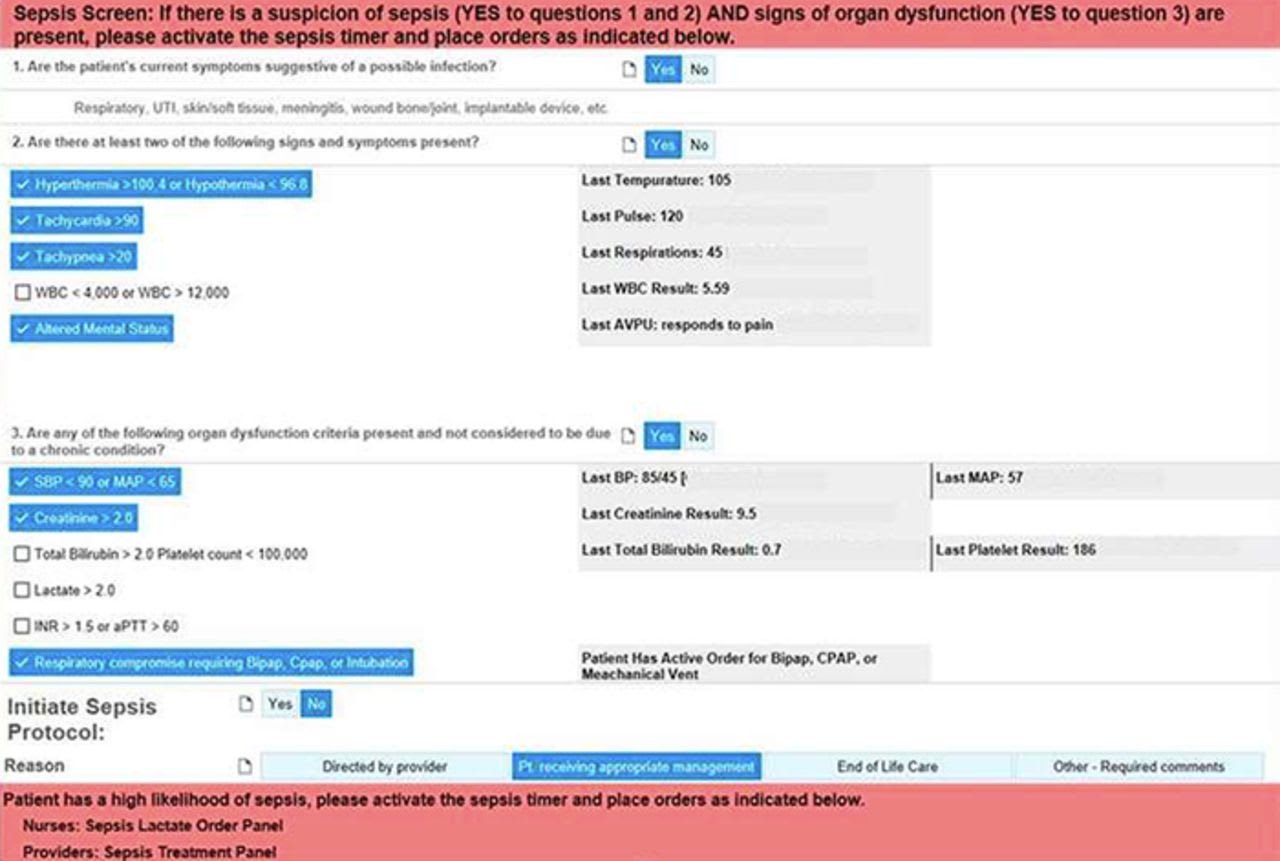
Implementation-focused summary
From noisy alerts to actionable care
The goal was earlier and more reliable identification of sepsis risk, paired with treatment optimization support that clinicians could trust and operationalize.
Challenge
Sepsis progression can be rapid, yet early signs are subtle and distributed across vitals, labs, and clinical notes. Traditional rule-based alerts often produce high false positive rates, contributing to alert fatigue and inconsistent adoption.
System design
A feature pipeline aggregated vitals, labs, medication administrations, and comorbidity profiles. A predictive model produced a calibrated risk score and trend, then surfaced an actionable pathway prompt (e.g., reassess, order cultures, initiate fluids/antibiotics per protocol) tailored to the clinical context.
Key components
Data
Streaming vitals + lab deltas + medication timing + prior history. Missingness handled explicitly (clinical reality, not a bug).
Model
Gradient-boosted trees + temporal trend features; emphasis on calibration and stable operating points across units.
Adoption
Alert routing matched to roles (nurse vs physician) and emphasized “next best action” rather than generic warnings.
Clinical impact (reported)
- Earlier identification of sepsis cases with improved sensitivity vs traditional rules, enabling faster intervention.
- Reduced false alarms and improved clinician trust through calibration and pathway-aligned alerts.
- Measurable reductions in sepsis-related mortality reported across participating hospitals after deployment and workflow integration.
Safety and governance
- Continuous monitoring for drift (seasonality, lab ordering patterns, population changes).
- Audit trails for alert delivery, acknowledgment, and follow-up actions.
- Regular multidisciplinary review with clinical leadership to tune thresholds and pathways.
Key technical outcomes
- Real-time streaming risk computation with EHR-native display and documentation.
- Contextualized recommendations mapped to established sepsis bundles.
- Reduced alert fatigue by focusing on clinically actionable, high-confidence signals.
References
-
Grooms E, Biesack K, Abban B, Kramer J. Rule‑Based Artificial Intelligence and Workflow to Prompt Early Sepsis Management: A Quality Improvement Project. Journal of Healthcare Quality. 2025.
https://pubmed.ncbi.nlm.nih.gov/40952916/ -
van der Vegt AH, Scott IA, Dermawan K, et al. Deployment of machine learning algorithms to predict sepsis: systematic review and application of the SALIENT clinical AI implementation framework. Journal of the American Medical Informatics Association. 2023;30(7):1349–1361.
https://academic.oup.com/jamia/article/30/7/1349/7161075 -
Abbas GH, Sen P, Giri OA, Khan NH. Artificial intelligence–based predictive modeling for early detection of sepsis in hospitalized patients: a systematic review and meta-analysis. Critical Care Explorations. 2025;7(12):e1360.
https://pubmed.ncbi.nlm.nih.gov/41348160/ -
Shanmugam H, Airen L, Rawat S. Machine learning and deep learning models for early sepsis prediction: a scoping review. Indian Journal of Critical Care Medicine. 2025;29(6):516–524.
https://pubmed.ncbi.nlm.nih.gov/40567322/ -
Singla B, Gupta P, Fatima A, et al. Real‑Time Artificial Intelligence for Early Sepsis Prediction Using Dynamic Clinical Data: A Systematic Review. Cureus. 2026;18(7):e113193.
https://www.cureus.com/articles/493124-real-time-artificial-intelligence-for-early-sepsis-prediction-using-dynamic-clinical-data -
Frontiers in Medicine. Early detection of sepsis using machine learning algorithms: a systematic review and network meta-analysis. 2024.
https://www.frontiersin.org/journals/medicine/articles/10.3389/fmed.2024.1491358/full -
Frontiers in Digital Health. Artificial intelligence based predictive models for early sepsis detection in intensive care units: a scoping review.
https://www.frontiersin.org/journals/digital-health/articles/10.3389/fdgth.2026.1794922/full