Implementation-focused summary
Turning a model into a trusted workflow tool
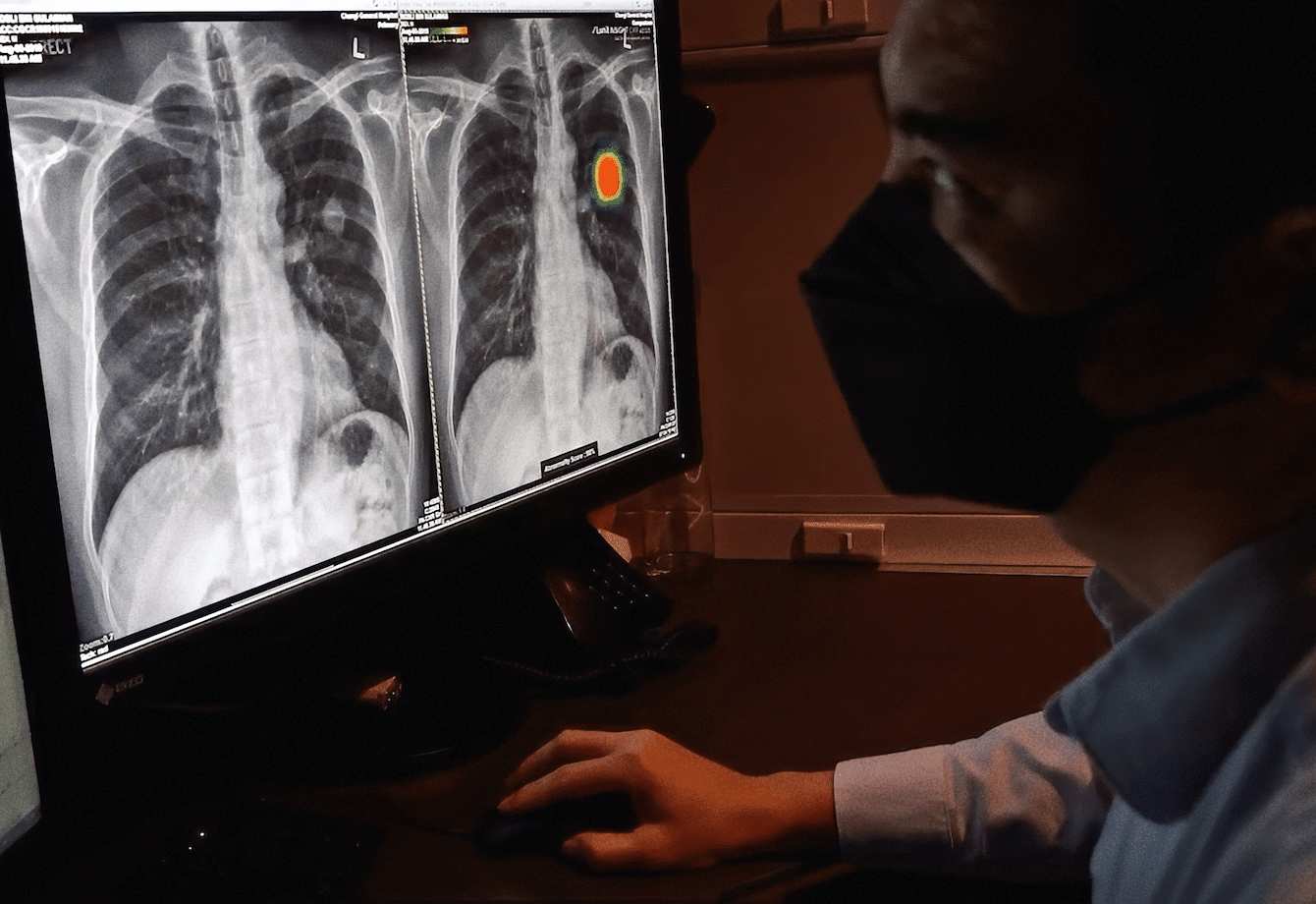
Triage support for large CXR backlogs, aimed at faster review of time-sensitive findings without forcing automation into clinical decision-making.
Problem
High-volume radiology settings often face peaks in incoming studies, where clinically urgent CXRs may wait behind routine imaging. The cost is not only delay but unpredictability (high variance in turnaround time), which is operationally hard to manage.
Approach
A CNN-based classifier flagged studies with likely urgent findings (e.g., pneumothorax, pleural effusion, consolidation patterns) and wrote back a structured triage score to the worklist. Rather than “auto-diagnosing,” the system re-ordered attention and surfaced supporting evidence and confidence context.
System workflow
Integration
PACS/DICOM ingestion → inference service → triage metadata → worklist prioritization and audit trail.
Governance
Shadow validation, drift tracking, and periodic retrospective QA with radiologist feedback loops.
Human factors
Designed as triage + attention routing; radiologists retained full control of reporting and escalation.
Operational impact (reported)
- Reduced mean time-to-review for urgent cases by prioritizing them earlier in the queue.
- Decreased variance in turnaround times, supporting more predictable radiology operations.
- Improved detection of subtle, time-sensitive imaging patterns when combined with standard review (decision support).
Deployment notes
- Calibrated to local prevalence and imaging protocols to avoid over-triage.
- Included a clear “why” explanation layer (confidence + common pattern descriptors) rather than opaque alerts.
- Added monitoring for changes in scanner mix, protocol shifts, and labeling practices.
References
-
Purohit S, et al. Bridging the gap: implementing low‑cost AI radiology services for chest X‑ray interpretation in resource-limited settings. Journal of Population Therapeutics and Clinical Pharmacology. 2022.
https://jptcp.com/index.php/jptcp/article/view/10391 -
World Bank AI Repository. Lunit INSIGHT CXR: AI in Radiology – Hospital Israelita Albert Einstein case study.
https://airepository.worldbank.org/use-case/lunit-insight-cxr-ai-radiology -
Lunit AI. Comprehensive chest X‑ray AI detection software (Lunit INSIGHT CXR). Product and clinical resources (links from case study above).
Follow the “Sources” section on the World Bank use‑case page for Lunit clinical papers and technical blog posts. -
TorchXRayVision (Lunit & collaborators). TorchXRayVision: chest X‑ray AI models and tools. Open-source repository.
https://github.com/mlmed/torchxrayvision -
Fleuren LM, Klausch TLT, Zwager CL, et al. Machine learning for the prediction of sepsis: a systematic review and meta-analysis of diagnostic test accuracy. Intensive Care Medicine. 2020;46:383–400.
Context reference for ML in imaging and early detection pipelines related to chest imaging and sepsis. -
NVIDIA Developer Blog. Deep learning for chest X‑ray analysis with Lunit INSIGHT CXR.
Linked from the World Bank AI Repository “Sources” section for Lunit INSIGHT CXR.